


Evaluation Is The Key To Success
- Martin Lee Yuen Ming

- Oct 29, 2018
- 3 min read
To evaluate your decisions and actions in your campaign, is to mainly discover what went right and what went wrong with everything so far.

Evaluation comes in numerous ways. Take your daily experiences for example, from deciding on what to eat for lunch and which restaurant to choose, to reflecting on what you have done throughout the day when you have trouble sleeping at nights.
Evaluation is defined as a process that critically examines a program, it involves compiling and analyzing information about a program’s characteristics, activities and outcomes (Zint, 2018). It should be used as a continuing management and tool to form perceptions about a program and how to improve its overall effectiveness.
To accomplish successful outcomes in any of your plans, you first have to evaluate the current state and identify its flaws, hence start working towards resolving those flaws and improving your campaign from there in a progressive manner.

According to West (2018), it is important to evaluate campaigns to measure the success of the campaign. As a Public Relations practitioner, you should always measure the outcome of the activities conducted against the client’s expected business goals.
In any campaign planning, Public Relations practitioners often use the 10 point plan. In this PR plan, the last step of this planning process is evaluation, also known as modification. According to Clark (2015), there are two types of evaluation which are:


Here’s an illustration that could help picture the differences between Formative and Summative evaluations.

Previously, we have discussed on the S.M.A.R.T objectives created for the #CyberSAFE campaign that was organized by Digi Telecommunications and Cybersecurity Malaysia. #CyberSAFE is a program that focuses on creating greater awareness on the positive use of the Internet among children in schools and engage with various communities on the subject (Digi, 2018).

Using the two S.M.A.R.T objectives from earlier, let’s take a look at the possible formative and summative methods of evaluation for each of them.

SMART OBJECTIVE #1
To increase Malaysian’s Awareness on the importance of child safety on the Internet by 20% within six months from the commencement date of the campaign.
Formative Evaluation:
i) Conduct monthly polls to keep track of the progress, to determine how many people engaged on the subject through traditional and digital platforms.
ii) Media Monitoring – Track how many times has the news been published, where and when has it been published.
iii) Measure social media reach and engagement by counting the number of likes, comments, hashtag mentions every week (Instagram, Facebook, Twitter etc).
Summative Evaluation:
i) Analyse the total number of comments, likes, shares about the subject matter that were posted on social media platforms such as Instagram, Facebook, Twitter and others.
ii) Count the total number of certificates of acknowledgement that were distributed to participants for the online live-streaming sessions.
iii) Interview the participants and publics about the outcomes/engagement.
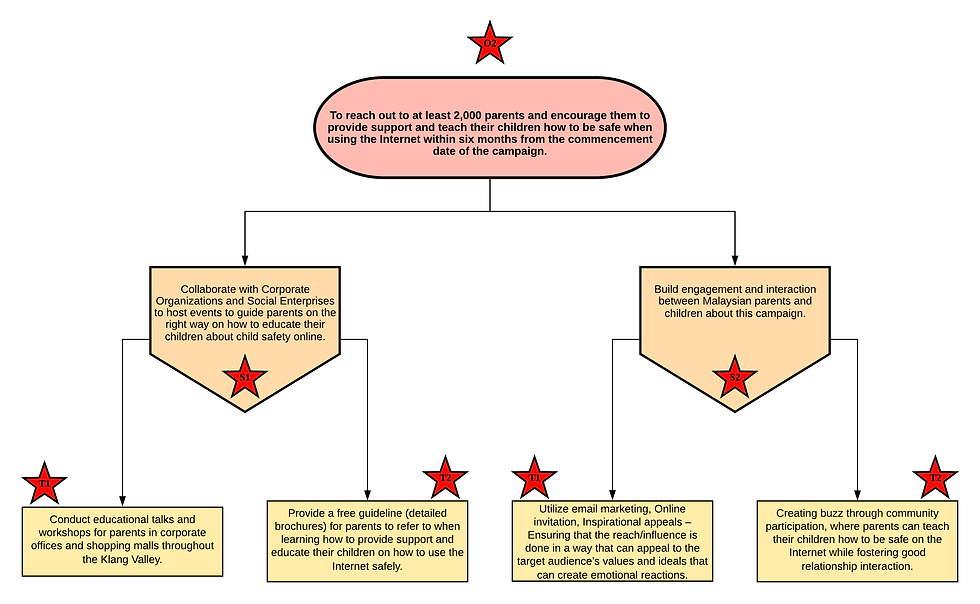
SMART OBJECTIVE #2
To reach out to at least 2,000 parents and encourage them to provide support and teach their children how to be safe when using the Internet within six months from the commencement date of the campaign.
Formative Evaluation:
i) Track the total amount of participants that registered for the talks and workshops every month.
ii) Monitor the effectiveness and responses of online invitations, email marketing every 2 weeks.
iii) Measure how many Internet Safety guidelines are distributed every month.
Summative Evaluation:
i) Measure event attendance and involvements of participants in educational talks and workshops.
ii) Measure the total number of Internet Safety guidelines that were distributed.
iii) Conduct online surveys to understand the views of parents and children.

That’s the end of my weekly blog, thank you for your support and
have a great week ahead!
*References
Clark, D. (2015) Types of Evaluations in Instructional Design. | Big Dog & Little Dog’s performance Juxtaposition. [online] Available at: http://www.nwlink.com/~donclark/hrd/isd/types_of_evaluations.html [Accessed 28 October 2018].
Digi. (2018) Digi CyberSAFE program in partnership with Cybersecurity Malaysia. | Digi Telecommunications. [online] Available at: https://www.digi.com.my/digicybersafe/ [Accessed 28 October 2018].
Pogue, S. (2018) 45 Powerful Planning Quotes to Help You Reach Your Goals. | Workzone. [online] Available at: https://www.workzone.com/blog/project-planning-quotes/ [Accessed 28 October 2018].
PR Mention. (2017) 10 Methods to Measure the Success of a PR Campaign. | PR Mention. [online] Available at: https://www.prmention.com/blog/10-methods-to-measure-the-impact-of-pr-campaign/ [Accessed 28 October 2018].
West, B. (2018) Evaluation Techniques Used in PR | Your Business. [online] Available at: https://yourbusiness.azcentral.com/evaluation-techniques-used-pr-21450.html [Accessed 28 October 2018].
Zint, M. (2018) Evaluation: What is it and why do it? | Meera. [online] Available at: http://meera.snre.umich.edu/evaluation-what-it-and-why-do-it [Accessed 28 October 2018].


Comments